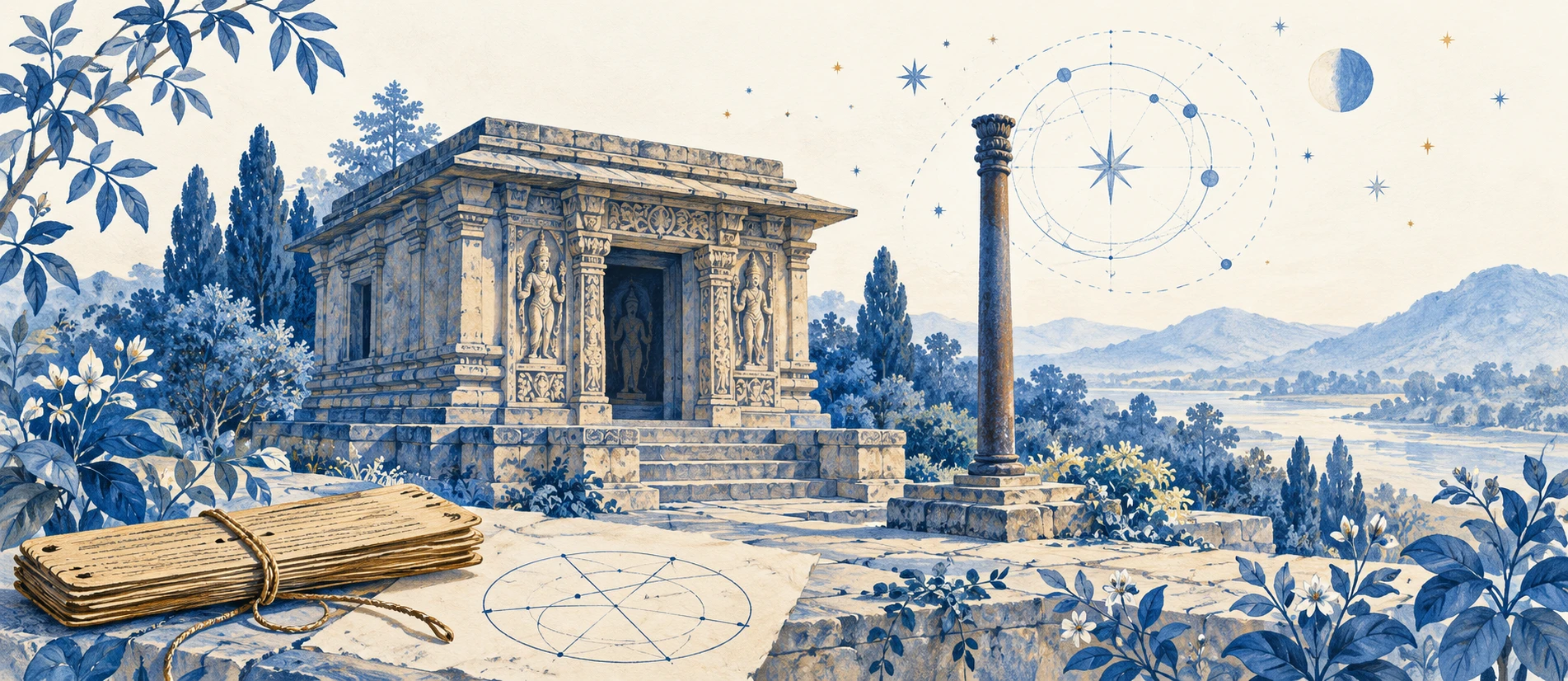
An iron pillar that has stood for more than 1,600 years. Stories carved into solid rock. A mathematician explaining why the stars seem to move across the sky.
These are some of the things that make the Gupta era so fascinating to me.
The Gupta Empire became a major power in northern India in the early fourth century CE. Often called India’s “Golden Age,” the period is remembered for achievements in mathematics, astronomy, literature, art and architecture. What interests me most is the imagination behind those achievements. How did people turn the materials and knowledge they had into things we still admire today?
Finding the empire on the map
The empire expanded under rulers such as Samudragupta and Chandragupta II. Its heartland lay in northern India, while conquests, alliances and relationships with neighbouring kingdoms extended its influence.
This map shows the Gupta world around 400–450 CE. The different shades help distinguish approximate imperial territory, uncertain frontiers and the independent allied Vakataka realm.
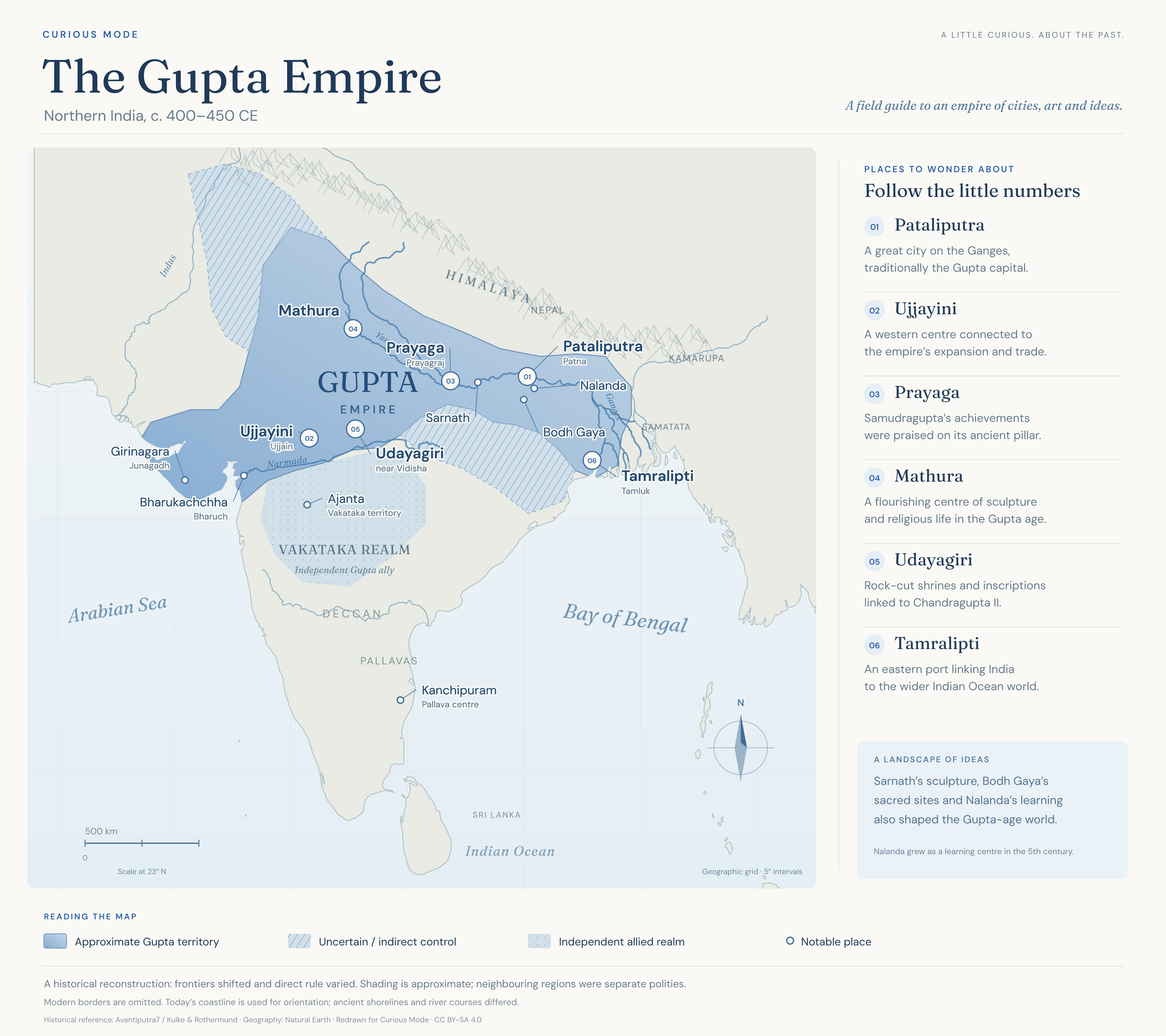
Open the map to explore it at full size. Historical reference: Avantiputra7, based on Kulke and Rothermund. Redrawn for Curious Mode under CC BY-SA 4.0. Geography: Natural Earth, public domain. Boundaries are approximate; the coastline is modern.
Places such as Pataliputra, Ujjayini, Mathura and Tamralipti help me picture an empire connected by cities, rivers and trade.
Remarkable things people built
Between the fourth and sixth centuries CE, builders developed stone and brick temples that helped shape later Hindu architecture. Hindu, Buddhist and Jain traditions inspired sculptures, shrines and places of learning across the subcontinent.
The Iron Pillar of Delhi
The Iron Pillar is famous for its remarkable resistance to rust after more than 1,600 years. The iron’s composition and a protective surface layer help explain its survival. Research by metallurgist R. Balasubramaniam connects that protection to the iron’s phosphorus content.
I find this amazing: ancient craftspeople made something that scientists are still studying centuries later. The pillar makes me curious about how much they learned through observation and practice.
The Udayagiri Caves
Near Vidisha in Madhya Pradesh, the Udayagiri Caves contain sculptures and inscriptions associated with Gupta rulers. One famous relief shows Varaha, Lord Vishnu’s boar incarnation, rescuing Bhudevi, the Earth goddess.
The sculpture turns a story about restoring order into something you can see in the rock itself. I admire the patience and skill that must have taken. An inscription at Cave 6 links the site to Chandragupta II.
The Bhitargaon Temple
In Uttar Pradesh, the Bhitargaon Temple shows what builders could achieve with brick and terracotta. Its panels include religious figures and mythological scenes. Ordinary materials became a carefully planned structure filled with detail.
To me, that is one of the most exciting things about architecture: creativity can begin with something as simple as a brick.
The Dashavatara Temple
The Dashavatara Temple at Deogarh, Uttar Pradesh, is dedicated to Lord Vishnu and dates to around the sixth century CE. Its carved panels tell stories from Hindu mythology.
The building brings together planning, craftsmanship and religious belief. Looking at its sculptures makes me wonder how the artists decided which moments of a story to capture.
The Ajanta and Bagh Caves
The Ajanta Caves in Maharashtra are known for Buddhist paintings, sculptures, monasteries and prayer halls. Their artwork includes Jataka tales, episodes from the Buddha’s life and glimpses of clothing, jewellery and everyday society.
Ajanta’s later artistic phase flourished during the broad Gupta age, under Vakataka patronage. This distinction matters: creativity was flourishing in neighbouring kingdoms too. UNESCO’s account of Ajanta explains its two main building phases.
The Bagh Caves in Madhya Pradesh also preserve traces of Buddhist mural painting from this broader period. Much of the artwork has been lost or damaged. The surviving fragments remind me why protecting old monuments matters: once a painting disappears, part of its story disappears with it.
The rulers behind the empire
The dynasty’s early rulers included Shri Gupta and Ghatotkacha. Chandragupta I helped it grow into a major power, strengthening its position through alliances, including his marriage to a Lichchhavi princess.
Several later rulers shaped its history:
- Samudragupta expanded Gupta power through military campaigns. His coins also show him playing a stringed instrument—a detail I especially like because I enjoy music.
- Chandragupta II, also known as Vikramaditya, expanded the empire westwards by defeating the Western Kshatrapas.
- Kumaragupta I ruled during much of the first half of the fifth century. Nalanda’s growth as a major monastic and learning centre belongs to the fifth-century Gupta world.
- Skandagupta faced military pressures, including conflict with the Hunas, as the empire became harder to defend.
The Guptas also used diplomacy and marriage alliances. Their relationship with the Vakatakas shows how political influence could reach beyond directly governed territory.
Scholars who changed how people thought
Aryabhata: mathematics and a spinning Earth
Aryabhata wrote the Aryabhatiya in 499 CE, during the later Gupta period. He gave a close approximation of pi, 3.1416, and explained the apparent movement of the heavens through Earth’s rotation on its axis. The University of St Andrews’ account of his work describes these achievements.
I find it extraordinary that careful thinking and calculation could lead to such ideas without modern telescopes or computers.
Kalidasa: imagination in words
Kalidasa, usually associated with the Gupta age, was one of ancient India’s great Sanskrit poets and playwrights. His works include Raghuvamsha, Kumarasambhava and Abhijnanashakuntalam.
His place in this story reminds me that creativity takes many forms. Writing a play and solving a mathematical problem both begin with someone thinking deeply about something.
Varahamihira: a continuing tradition
Varahamihira worked in the sixth century, as Gupta power declined and the tradition of learning continued. Based around Ujjain, he wrote on astronomy, astrology and many aspects of the natural world.
He belongs to the wider intellectual story of this era, rather than the earlier reign of Chandragupta II. His biography at the University of St Andrews explores his work at Ujjain.
How the empire worked
The king governed with the help of ministers and officials. Provinces and districts divided up the work of administration, while local officials and village leaders handled many everyday matters. Armies, alliances and cooperation with regional rulers helped maintain imperial power.
Agriculture supported much of the economy, and taxes on farming helped fund the government. Craftspeople produced goods, merchants traded them, and routes such as the Uttarapatha and Dakshinapatha connected regions. Textiles, spices and other products travelled through inland markets and ports.
Behind the famous rulers and monuments were farmers, builders, traders and artisans whose work kept society going.
Why the empire declined
The Gupta Empire gradually weakened under several pressures. Huna invasions strained its defences. Disputes within the dynasty and the growing independence of regional rulers made it harder to hold the empire together. Warfare also placed demands on resources.
By around the middle of the sixth century CE, the empire had largely broken apart. Its political decline happened gradually, and learning and artistic work continued in the kingdoms that followed.
What stays with me
What amazes me most about the Gupta era is the variety of things people created: a durable iron pillar, expressive sculptures, carefully planned temples, poetry and ideas about the sky.
I keep coming back to the effort behind them. Someone had to practise a skill, test an idea or keep working when a task was difficult. That feels familiar, even across so many centuries.
For me, the Gupta era is a reminder that curiosity, creativity and patient work can leave something that lasts.
Keep exploring
Still learning. Always curious.
— Curious Mode