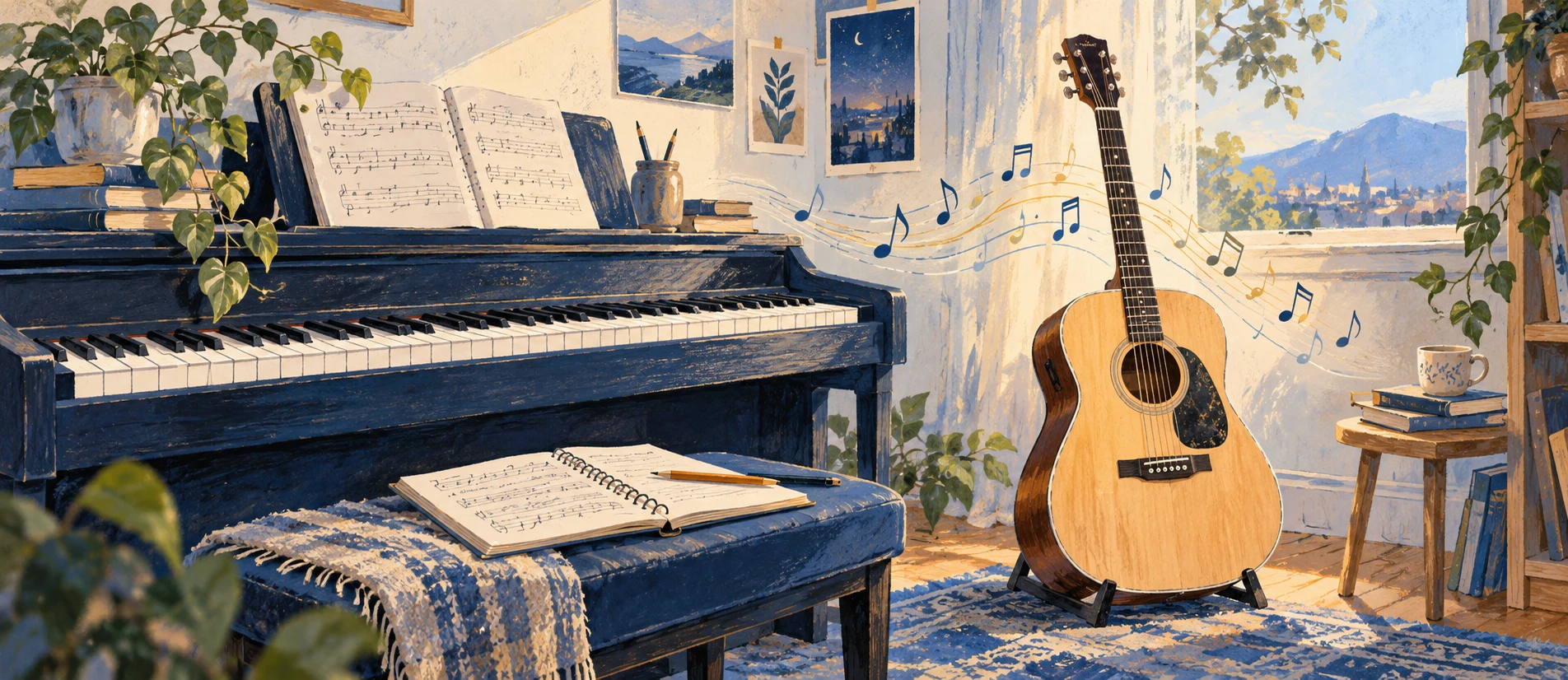
Whenever I listened to my favourite songs, I used to think, “Why can’t I play these myself? How cool would it be to play an instrument and sing along?”
That question was the beginning of my music journey. I didn’t know it then, but a little curiosity was going to turn into a big part of my life.
My first notes
I started playing the piano when I was very young. At first, YouTube videos and learning apps were my teachers. I was mostly self-taught until I started taking lessons later on.
The more I played, the more I noticed in the music I heard: the rhythm, the melody, and the feeling behind a song. Some songs made me happy. Others reminded me of a memory or made an ordinary moment feel special. I wanted to understand how to create those feelings myself.
Of course, wanting to play something and actually playing it are two very different things! I made mistakes, got stuck, and sometimes felt as if I wasn’t improving quickly enough.
But every small improvement made me want to keep going. I began to realise that music takes more than talent. It takes patience, practice, and the courage to try again.
Grade 5: nerves, practice, and a surprise
My mum suggested taking piano grade exams, and I began preparing for Grade 5 with my teacher. I had to fit piano practice around my schoolwork, learn new pieces, and keep working on the parts I found difficult.
Then exam day arrived. It was an online exam, and I gave it everything I had. Afterwards, though, I couldn’t stop wondering whether I had made mistakes or would get a disappointing result.
My teacher told me to stay calm. My mum helped me stop worrying too. She reminded me that, as long as I had given my best, she would always be proud of me.
When the result came, I had scored 72 marks. I had been hoping for more than 85, so it wasn’t what I expected. But I couldn’t change that exam. I could only decide what to do next.
I decided to use it as motivation.
Grade 7: the result I had worked for
I skipped Grade 6 and went straight to preparing for Grade 7. This time, I paid closer attention to everything: the notes, the dynamics, and how precisely I played each piece.
My mum and teacher decided that I would take this exam in person. I practised my pieces, scales, and aural work carefully, and when I came out of the exam, I felt much more confident.
I thought I might get a distinction—and I did!
92 marks. Distinction.
I was so happy. After the disappointment of my first result, it felt brilliant to see my practice pay off.
Grade 8—and a new beginning
Next came Grade 8. I kept practising and used what I had learned while preparing for my earlier exams. This time, I earned a Merit.
It wasn’t a distinction, but I was still happy with my result. I had completed Grade 8, and I felt proud of how far I had come.
Then something exciting happened. There was a music store one floor below the exam hall, and after the exam I bought a guitar!
I went home with my mum and started learning. Just as I had done with the piano, I turned to an app and YouTube to help me get started.
Now I’m a beginner again, figuring out a different instrument. I haven’t taken a guitar grade exam yet. There’s still plenty to learn.
Finding my own music
Along the way, I’ve also started writing music of my own. That feels like another way to tell my story: not just playing songs I love, but trying to express my own ideas and feelings.
Music has helped me understand myself better and connect with people who enjoy the same things. It has also made me curious about different cultures and the stories their music tells.
When I look back, I think about more than the exam marks. I remember teaching myself those first notes, the nerves before a result, the practice that helped me improve, and the excitement of bringing home my guitar.
My journey started with a question: “Why can’t I play these songs myself?”
Now I can—and I’m curious to find out what I’ll play, learn, and write next.
Still learning. Always curious.
— Curious Mode